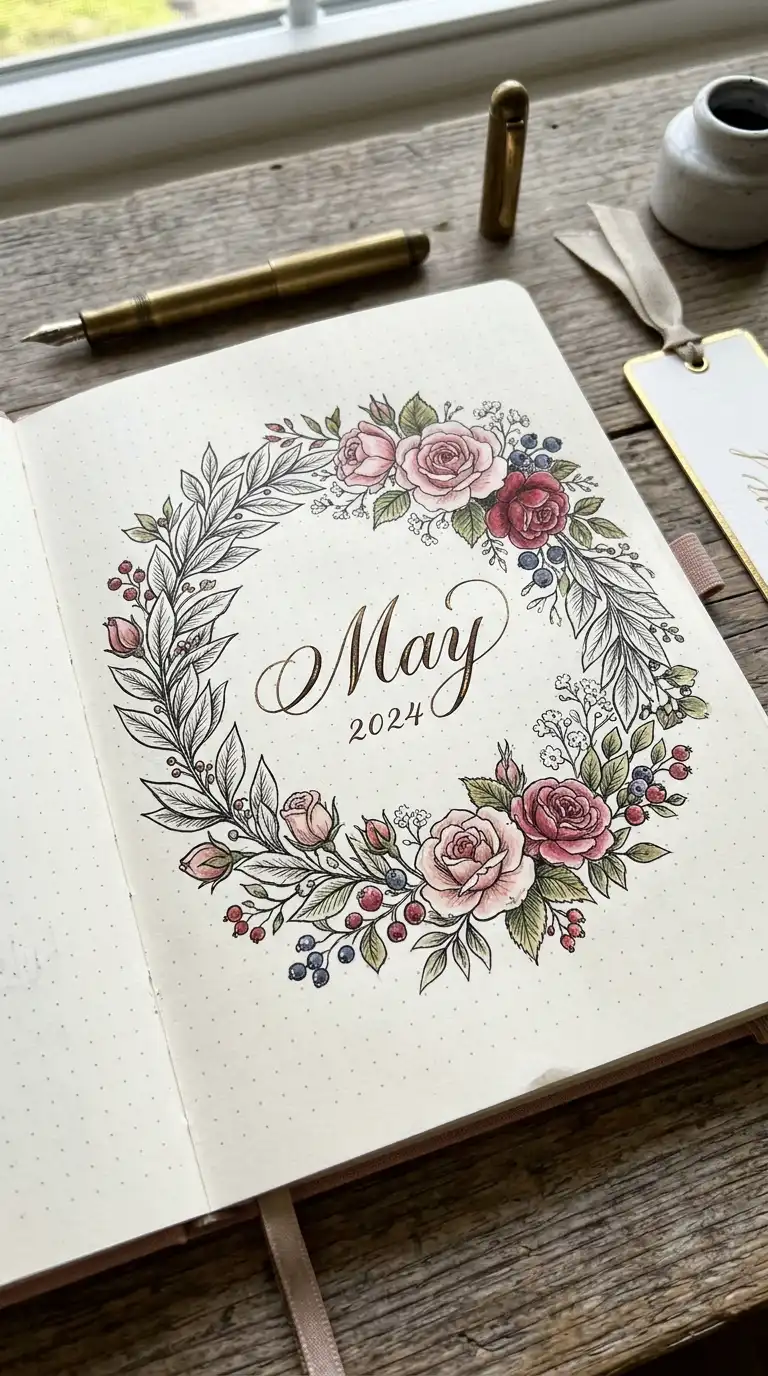
15 Bullet Journal Monthly Spread Ideas
The Bullet Journal is more than a planner—it’s a customizable system for tracking your life, your habits, and your growth. Setting up monthly spreads within your BuJo transforms it from a simple log into a powerful tool for intentional living. Below are 15 monthly spread ideas that will help you organize, reflect, and achieve what matters most.
1. The Goal Setting Spread
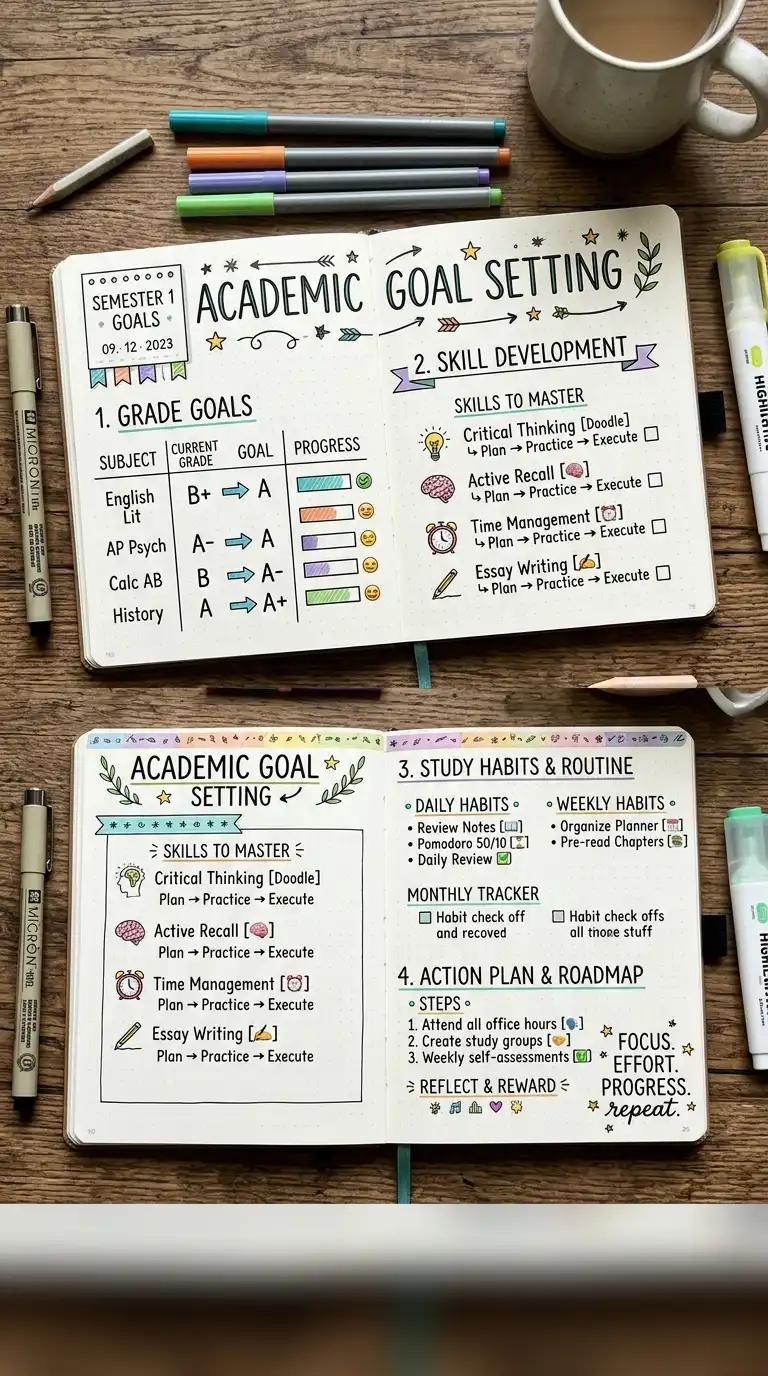
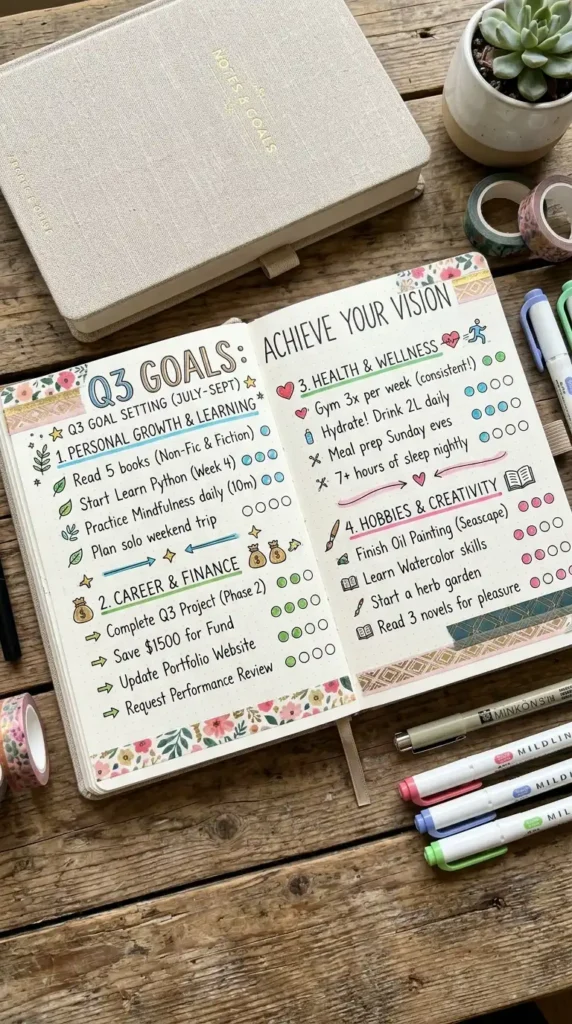
Dedicate a two-page spread at the beginning of each month to clearly define what you want to accomplish. This is your roadmap for the next 30 days.
Divide your goals into categories that matter to you: Personal Growth, Career, Health & Fitness, Relationships, Finances, and Home. Under each category, write 2–3 specific, measurable goals. For example, instead of “get fit,” write “complete 15 workout sessions this month.”
QUICK TIPS
- Use the SMART framework: Specific, Measurable, Achievable, Relevant, Time-bound.
- Limit total monthly goals to 10–12 to avoid overwhelm.
- Leave space next to each goal to track progress throughout the month.
2. The Habit Tracker Spread
Habits are the building blocks of a productive life. A habit tracker spread allows you to visually monitor daily behaviors that support your larger goals.
Create a grid with the days of the month across the top and your habits down the side. Habits might include: morning meditation, reading 20 minutes, drinking 8 glasses of water, no social media before 9am, or daily journaling. Each evening, fill in the corresponding square for each habit you completed.
QUICK TIPS
- Start with 5–7 habits—any more becomes overwhelming and unsustainable.
- Use a color-coding system: green for done, yellow for partial, red for missed.
- Review your habit tracker weekly to identify patterns and adjust as needed.

3. The Monthly Focus Theme Spread
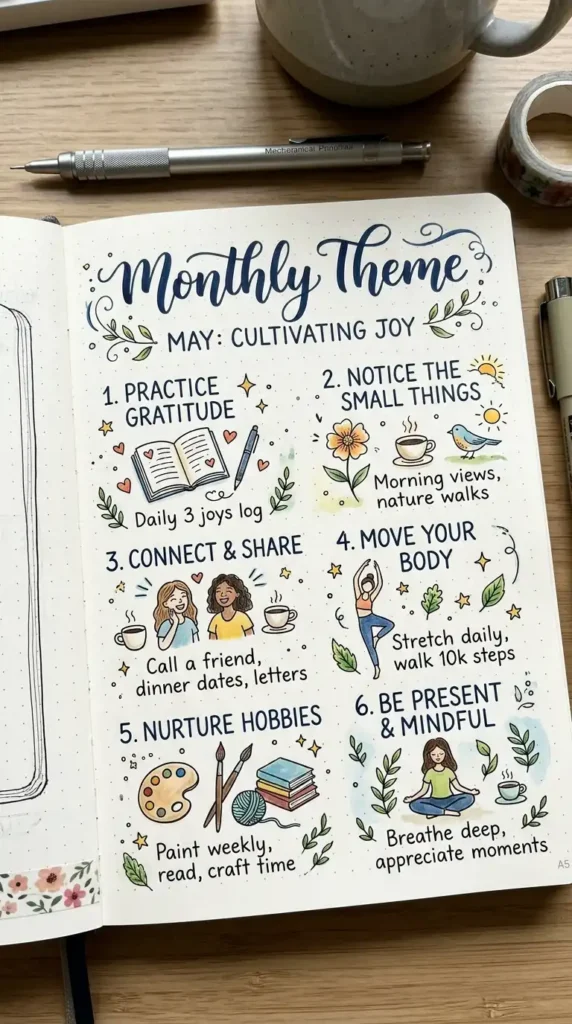
Instead of trying to change everything at once, choose one overarching theme for the month. This gives your efforts focus and coherence.
Your theme might be “Health Reset,” “Financial Discipline,” “Creative Exploration,” or “Minimalism.” Create a spread that explores what this theme means to you: why you chose it, what actions support it, and what you hope to learn or achieve. Include a small section for daily reflections on how the theme is showing up in your life.
QUICK TIPS
- Choose a theme that aligns with your seasonal energy (e.g., decluttering in spring, reflection in winter).
- Write the theme at the top of each weekly spread as a reminder.
- At month-end, write a short reflection on how the theme impacted your month.
4. The Monthly Review Spread
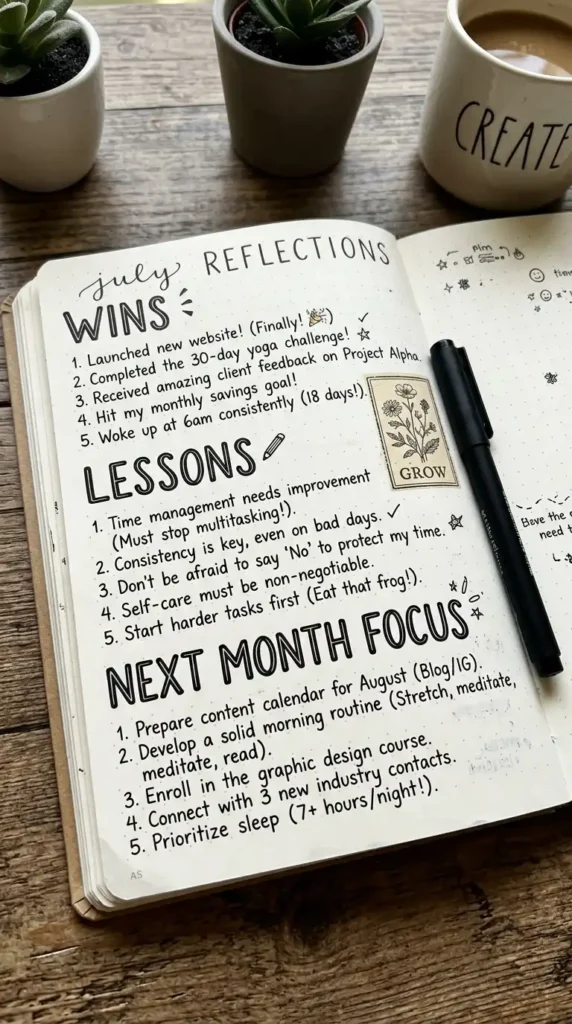
Before you can plan forward, you must reflect backward. A monthly review spread helps you learn from the past 30 days and set intentions for the next.
Include sections for: What Went Well (celebrate your wins), What Could Be Improved (honest assessment), Lessons Learned (takeaways), and One Thing I’ll Do Differently Next Month. This spread should be completed on the last day of the month before you begin planning the new one.
QUICK TIPS
- Be brutally honest in the “What Could Be Improved” section—growth requires self-awareness.
- Celebrate even small wins—they build momentum for bigger achievements.
- Use this spread to inform your goal-setting for the next month.
5. The Brain Dump & Priority Matrix
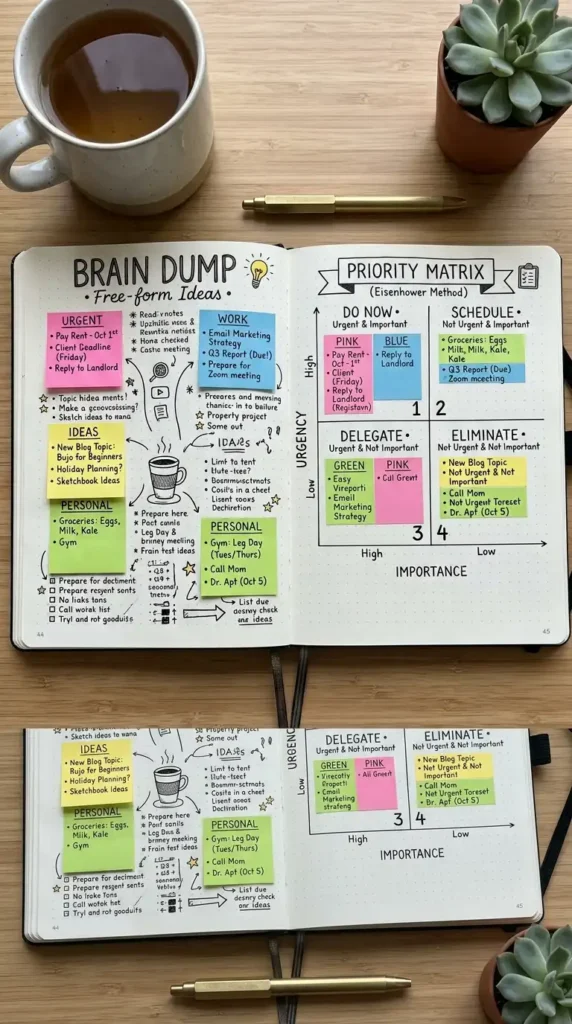
Before you can plan your month, you need to clear your mental clutter. A brain dump spread gives you space to offload everything that’s on your mind—tasks, worries, ideas, appointments, and random thoughts.
Once the brain dump is complete, use a priority matrix to sort the items by urgency and importance. Create four quadrants: Important & Urgent (do now), Important & Not Urgent (schedule), Not Important & Urgent (delegate), and Not Important & Not Urgent (eliminate). This visual clarity makes planning your month far easier.
QUICK TIPS
- Set a timer for 10 minutes and write continuously—don’t edit or judge.
- Use sticky notes for the brain dump so you can easily move items into the matrix.
- Review the priority matrix weekly to ensure you’re staying on track.
6. The Monthly Calendar Grid
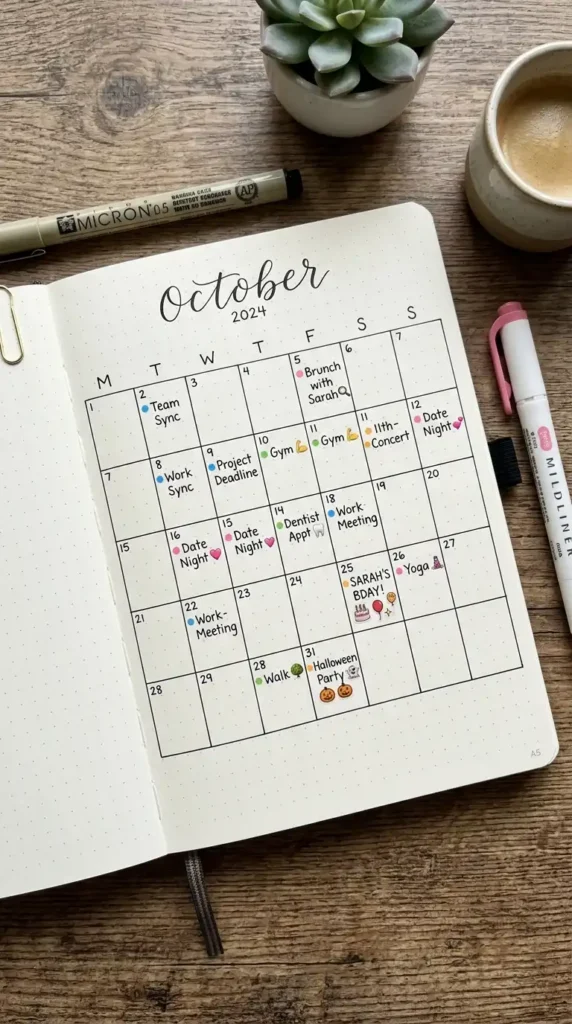
A monthly calendar grid is the backbone of any BuJo. This spread provides a high-level view of your month, helping you see appointments, deadlines, and events at a glance.
Draw a simple grid with 31 boxes (or the appropriate number for the month). Fill in dates and days of the week. Use this space to note: birthdays, appointments, deadlines, travel, and important events. Keep it clean—this isn’t the place for detailed to-do lists, just a bird’s-eye view of your month.
QUICK TIPS
- Use different colored pens for different types of events (blue for work, green for personal, red for deadlines).
- Add a small notes section at the bottom for things that don’t fit in the grid.
- At the end of the month, review this spread to see how your time was actually spent.
7. The Mood Tracker Spread
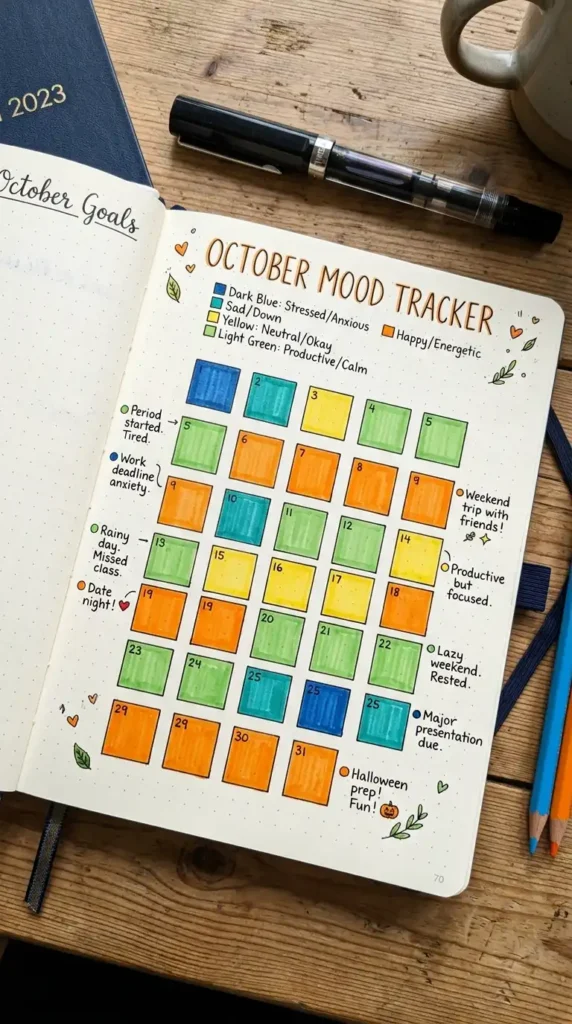
Your emotional health is just as important as your physical health. A mood tracker helps you identify patterns in how you feel and what factors influence your daily emotional state.
Create a grid with the days of the month on one axis and emotions or energy levels on the other. Each day, color in the corresponding square based on how you feel. You might track: mood (sad, neutral, happy, excited), energy level (low, medium, high), or anxiety level (1–10). Over time, patterns will emerge that help you make better lifestyle choices.
QUICK TIPS
- Use a color scale that makes sense to you—warm colors for positive moods, cool colors for negative.
- Pair your mood tracker with a short daily note about what contributed to that mood.
- Review your mood tracker monthly to identify triggers and supports.
8. The Gratitude Log
Gratitude is one of the most powerful practices for improving mental wellbeing. A gratitude log spread gives you a dedicated space to record what you’re thankful for each day.
Simple is best here. Each day, write one to three things you’re grateful for. They can be as small as a good cup of coffee or as significant as a promotion. The practice of noticing and recording gratitude rewires your brain to focus on the positive rather than the negative.
QUICK TIPS
- Aim for variety—don’t just repeat the same things every day.
- Try to be specific rather than general (“the sunset” vs. “the beautiful pink and orange sunset”).
- At month-end, read back through your gratitude log to boost your mood.

9. The Monthly Budget Spread
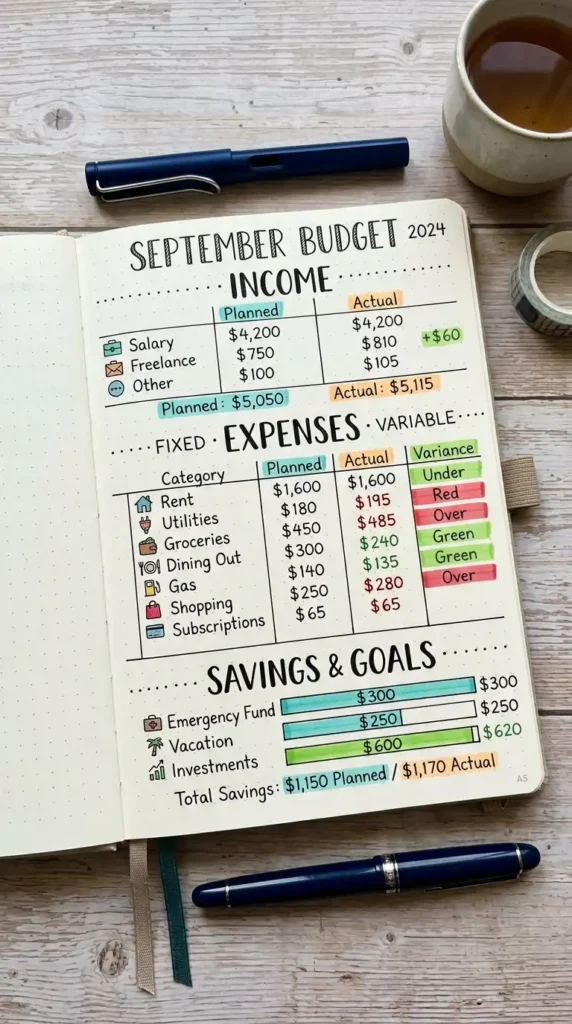
Financial goals are among the most common New Year’s resolutions, but they require monthly tracking to succeed. A budget spread keeps your finances visible and manageable.
Create sections for: Monthly Income, Fixed Expenses (rent, utilities, insurance), Variable Expenses (groceries, entertainment, dining out), and Savings Goals. Track your actual spending against your planned budget weekly. At month-end, summarize where you spent more or less than expected and adjust next month’s budget accordingly.
QUICK TIPS
- Use a different color for planned vs. actual spending for easy comparison.
- Include a section for irregular expenses (car maintenance, gifts) that don’t occur monthly.
- Review your budget spread quarterly to see big-picture trends.
10. The Monthly Self-Care Spread
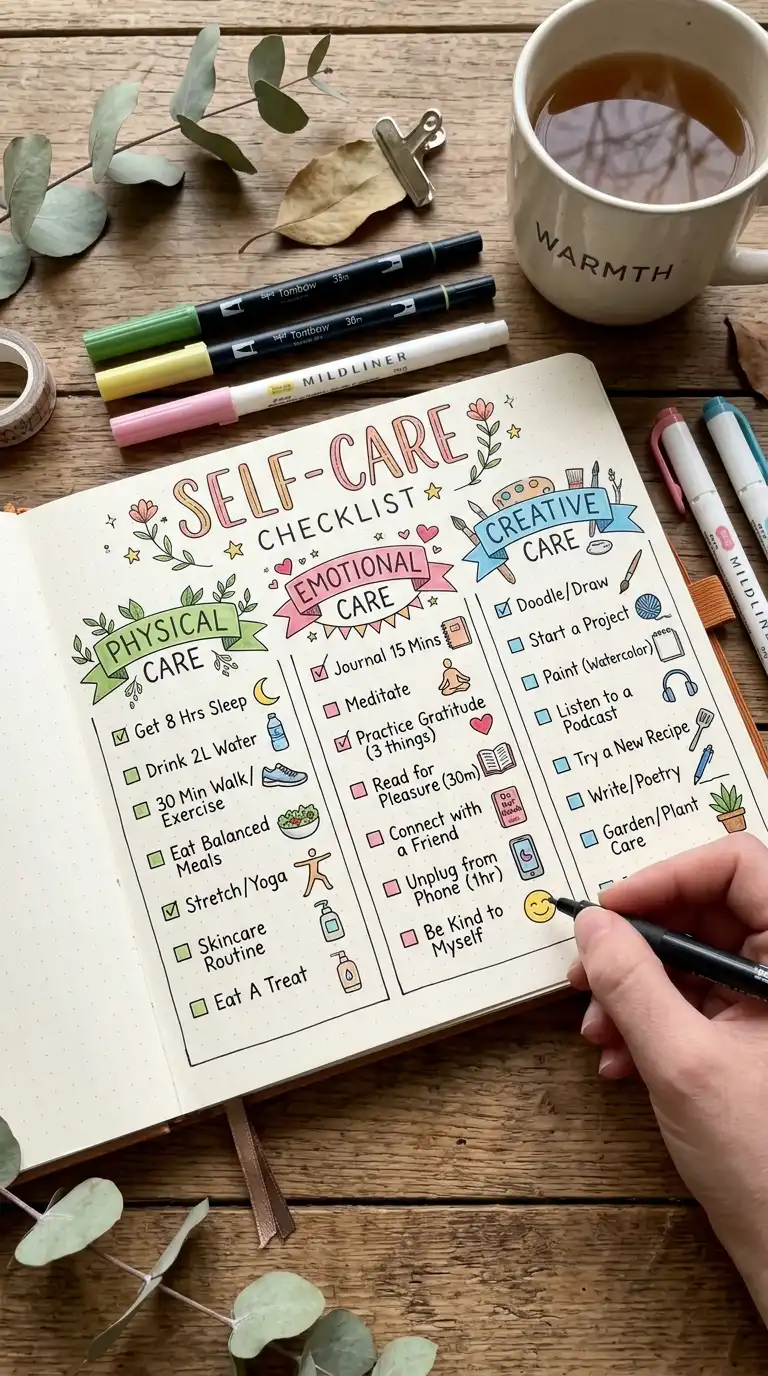
Self-care isn’t selfish—it’s essential. A self-care spread ensures you’re prioritizing your own wellbeing alongside your other responsibilities.
Create a checklist of self-care activities organized by category: Physical (exercise, sleep, healthy meals), Emotional (therapy, journaling, connecting with friends), Social (calling a friend, date night, family time), and Spiritual (meditation, nature walks, reading). Each week, aim to complete at least one activity from each category.
QUICK TIPS
- Schedule self-care activities on your monthly calendar just like any other appointment.
- Be realistic—don’t plan an hour of meditation if you can only manage five minutes.
- Self-care doesn’t have to cost money—a walk in nature or a home-cooked meal counts.

11. The Monthly Project Tracker
Some goals can’t be completed in a month—they require longer-term effort. A monthly project tracker keeps you accountable and prevents important projects from being forgotten.
List your active projects at the start of the month. For each project, note: the current status, the goal for this month, the next action step, and any obstacles you anticipate. At the end of the month, update each project’s status and move it to next month’s tracker if it’s still in progress.
QUICK TIPS
- Limit active projects to 3–5 to avoid spreading yourself too thin.
- Break large projects into monthly milestones to make them feel achievable.
- Use a symbol system: ongoing, blocked, completed, or on hold.

12. The Monthly Reflection & Intentions Spread
This is the closing spread of your monthly BuJo section—a space to capture the essence of the month and set the stage for the next. It’s both a celebration and a bridge forward.
Write down: Your proudest moment of the month, the biggest challenge you faced, the most important lesson you learned, one thing you discovered about yourself, and one intention for next month. The intention should be a single sentence that captures what you want to bring forward: “Next month, I intend to be more present with my family” or “Next month, I intend to prioritize my physical health.”
QUICK TIPS
- Write this spread on the last day of the month while the experiences are still fresh.
- Keep it positive—framing challenges as lessons helps build resilience.
- Read this spread before writing your goals for the next month.

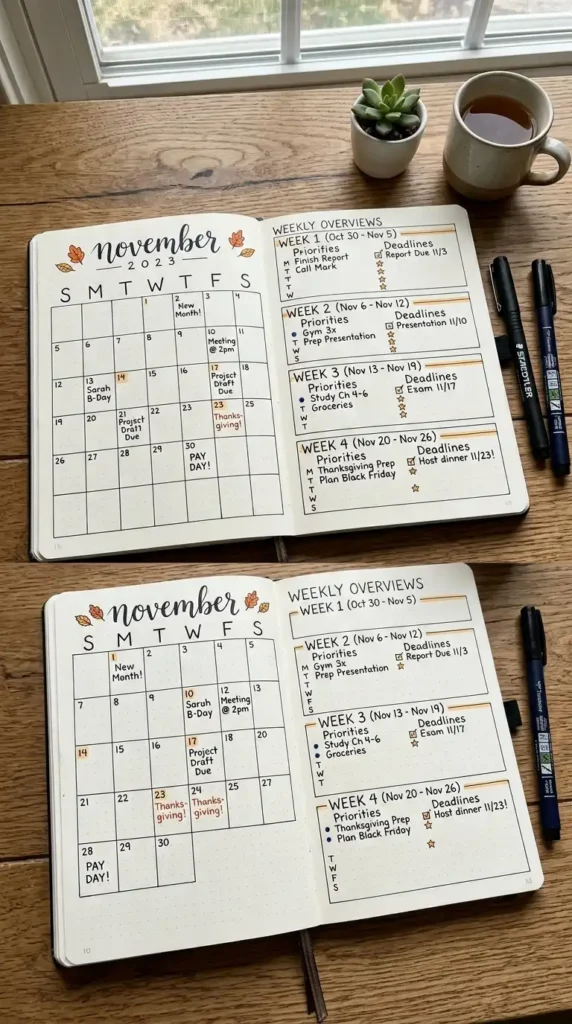
13. The Weekly Overview & Monthly Snapshot
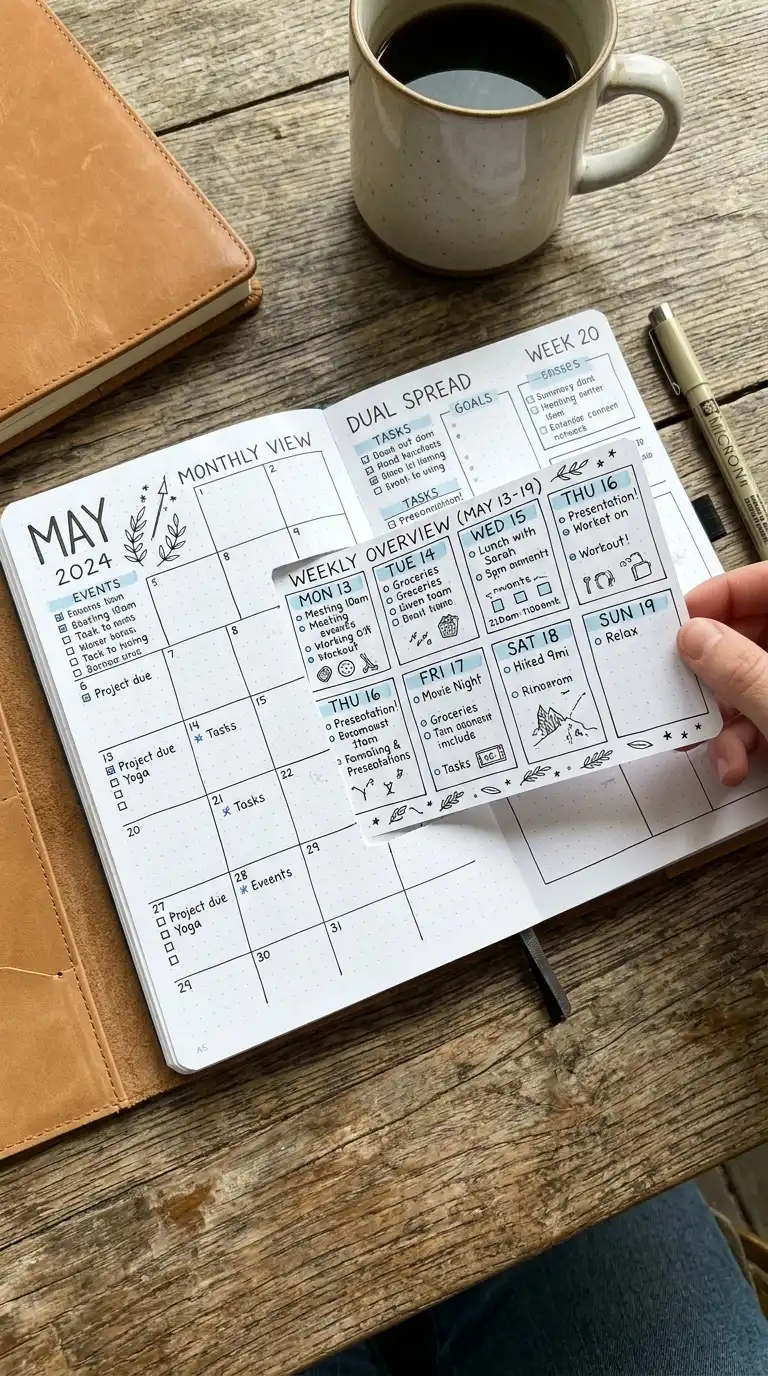
For those who like both a macro and micro view, combine a full monthly calendar with a weekly overview section. This spread gives you the big picture while leaving room for weekly planning.
Create the monthly calendar grid on one page. On the facing page, draw a section for each week of the month with space for key priorities, important deadlines, and a small to-do list. This layout is particularly helpful for busy professionals or students who need to balance long-term planning with weekly execution.
QUICK TIPS
- Keep the weekly sections small—only the most important items.
- Use the same color coding across both pages for consistency.
- Add a “monthly focus” line at the top to stay aligned with your theme.
14. The Sleep & Energy Tracker
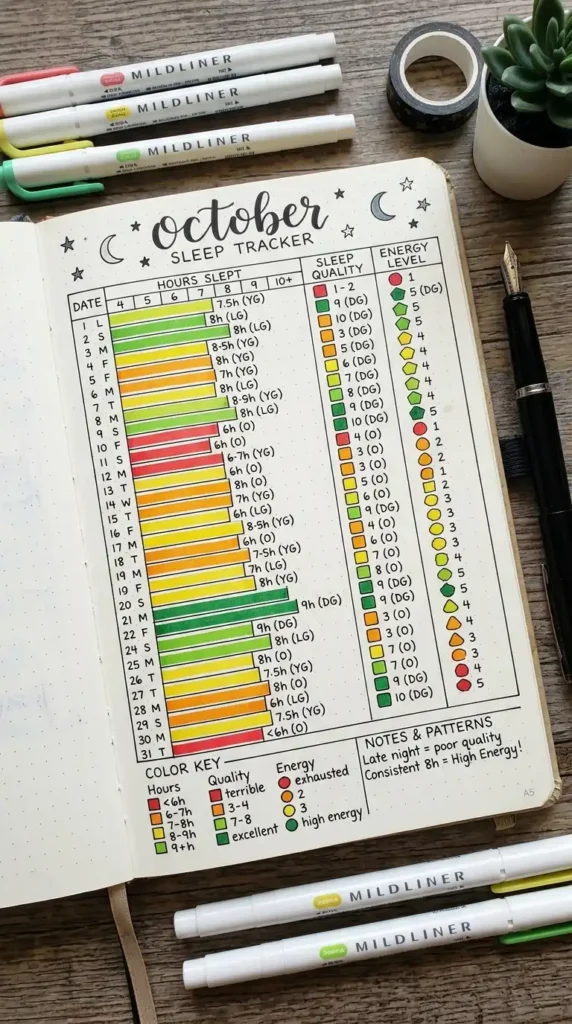
Sleep quality and energy levels directly impact productivity and wellbeing. A sleep tracker helps you understand your rest patterns and optimize your daily energy.
Create a grid with days of the month. For each day, record your hours of sleep, sleep quality (1–5), and energy level upon waking (1–5). Add a notes section for factors that affected your sleep: caffeine, stress, exercise, or screen time. Over time, you’ll identify patterns that help you make better sleep decisions.
QUICK TIPS
- Track for at least two weeks before looking for patterns.
- Include a “what helped” column to identify positive sleep habits.
- Consider tracking your wind-down routine as well.
15. The Creativity & Inspiration Log
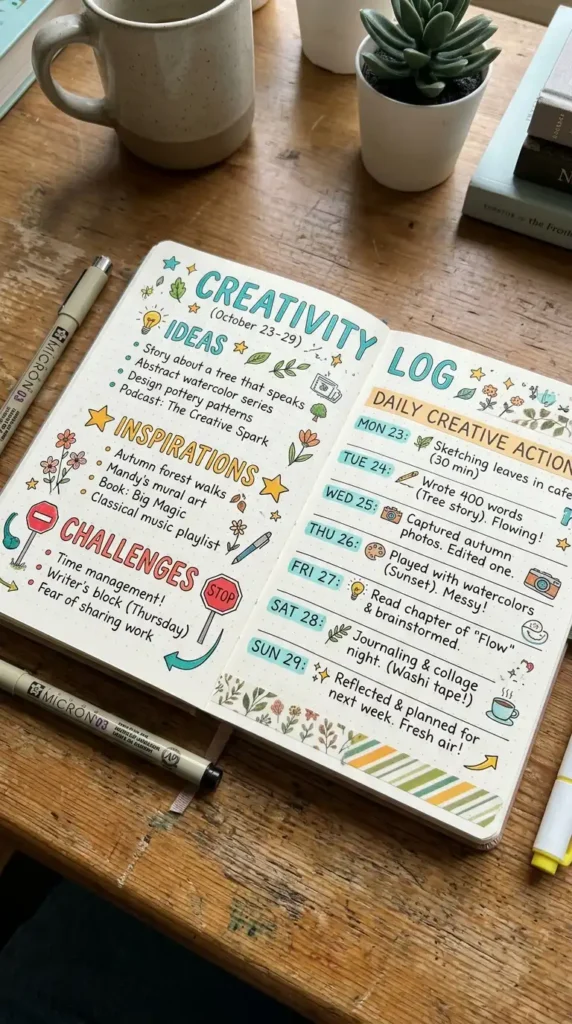
For creatives, artists, or anyone wanting to cultivate inspiration, a creativity log captures ideas, sparks, and moments of insight that might otherwise be forgotten.
Create sections for: Creative Ideas (any spark or concept that arises), Inspirations (books, art, people, nature that inspired you), Challenges (creative blocks or obstacles), and Daily Creative Action (one small creative thing you did each day). This spread becomes a treasure trove of material to revisit when you need a boost.
QUICK TIPS
- Write down ideas immediately—even if they seem silly.
- Include visuals: small sketches, magazine clippings, or colored swatches.
- Review your creativity log monthly to find recurring themes or ideas worth pursuing.
Final Thoughts
Your Bullet Journal is a living document, not a museum piece. Don’t be afraid to experiment with these spreads, combine them in ways that work for you, or discard ideas that don’t serve your needs. The goal isn’t a perfect journal—it’s a tool that helps you live a more intentional, purposeful life.
Start with just two or three of these spreads this month. Add more as you develop the habit. Over time, your monthly BuJo section will become a ritual that grounds you, focuses you, and celebrates your growth—one month at a time.